JACQUES BRISSOT SAINT BRISSOT AUX MAINS D’ACIER « Le monde m’appartient et j’en fais ce que je veux »
Vernissage samedi 14 février 2026 de 18h à 21h
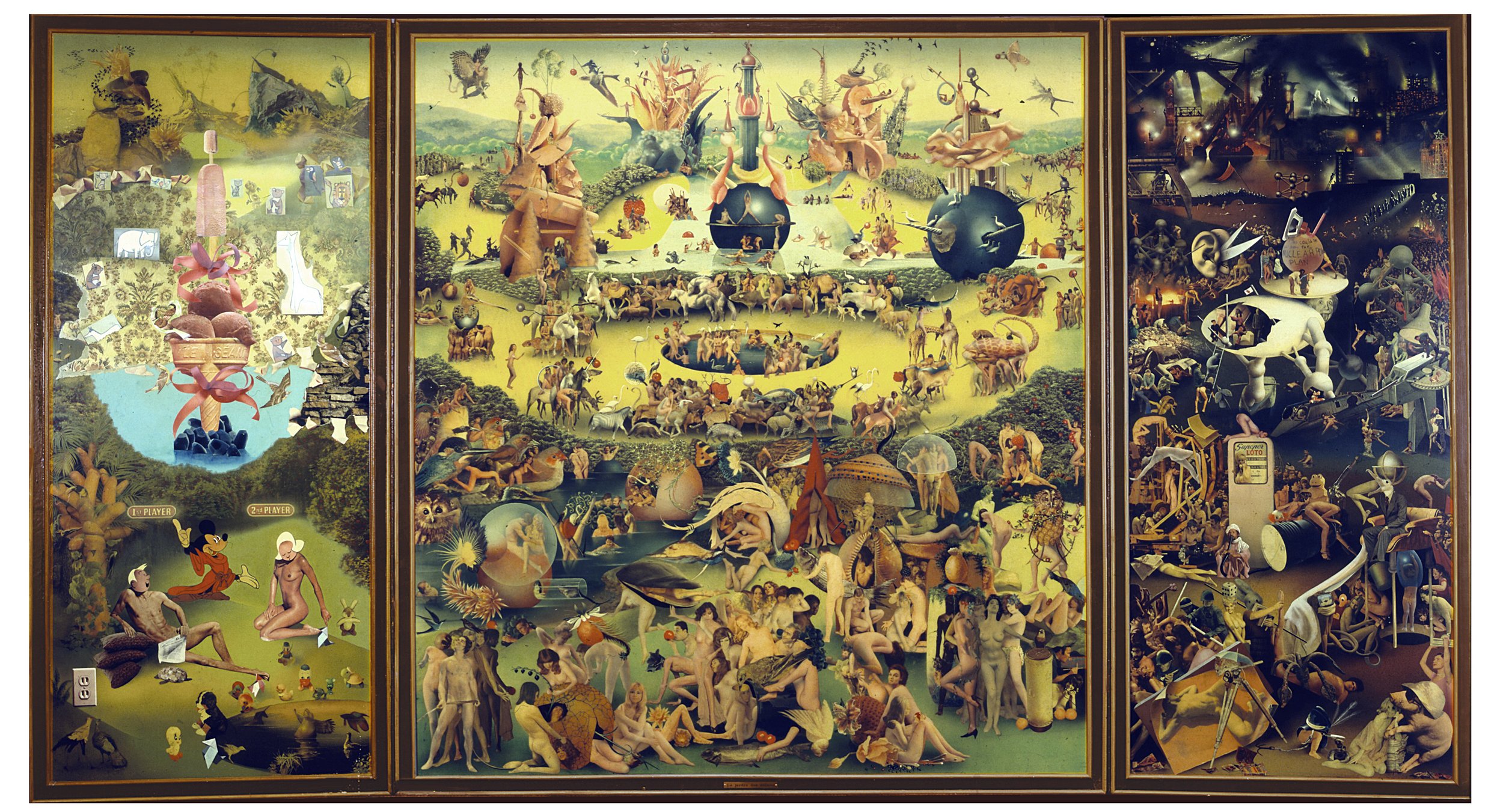
(…) Disparu en 2020, Brissot laisse derrière lui une production considérable, dont cette exposition ne présente qu’une sélection, nécessairement fragmentaire tant l’ensemble est vaste. Tableaux-collages, assemblages, dioramas et objets composites composent un corpus proliférant, indiscipliné, bâti sur l’appropriation, le détournement et la recomposition incessante des images.(…)
L’un des axes majeurs de son travail réside dans sa relation aux grands chefs-d’œuvre de la peinture occidentale. À partir de la structure de tableaux canoniques, de la peinture des primitifs flamands jusqu’aux visions de Jérôme Bosch et aux grandes compositions de Pieter Bruegel l’Ancien, ainsi que d’autres figures fondatrices, il compose des œuvres nouvelles en intégrant des images prélevées dans les journaux et magazines contemporains, qu’il découpe, détourne et assemble. Ces hybridations deviennent la matière première d’une iconographie inédite, où le sacré se mêle au grotesque, l’hommage à l’irrévérence, la citation à la profanation ludique.(…)
Formé d’abord au contact de figures majeures du cinéma telles qu’Henri Langlois et Pierre Schaeffer, Jacques Brissot évolue ensuite au plus près d’artistes comme Arman et Roland Topor, dans un milieu marqué par le goût du détournement, de l’excès et de la collision des registres. Il est exposé pour la première fois par le marchand d’art Jacques Kerchache, spécialisé dans les arts premiers. De ces circulations entre disciplines naît une œuvre farouchement singulière, échappant aux catégories, aux écoles et aux récits officiels. C’est précisément cette voie parallèle, presque secrète, qui rend aujourd’hui cette présentation essentielle.
Le regard de Louis-Ferdinand Nieto, qui accompagne cette exposition d’un texte inédit, constitue l’un des fils conducteurs du projet : celui d’un artiste vivant s’adressant à l’œuvre d’un artiste disparu, depuis l’intérieur même des pratiques, des obsessions et des recherches de l’atelier.(…)
(…) Brissot, who died in 2020, left behind an immense body of work, of which this exhibition presents only a selection, necessarily fragmentary given its vastness. Collage-paintings, assemblages, dioramas and composite objects form a proliferating, unruly corpus built on appropriation, diversion and the incessant recomposition of images.(…)
One of the central axes of his work lies in his relationship to the great masterpieces of Western painting. Starting from the compositional structures of canonical works, from Early Netherlandish painting through the visions of Hieronymus Bosch and the great panoramas of Pieter Bruegel the Elder, among other founding figures, Brissot constructs new works by inserting images taken from contemporary newspapers and magazines, which he cuts, diverts and assembles. These hybridisations become the raw material of a new iconography, where the sacred mingles with the grotesque, homage with irreverence, quotation with playful profanation.(…)
Initially shaped by encounters with major figures of cinema such as Henri Langlois and Pierre Schaeffer, Jacques Brissot later moved in close proximity to artists including Arman and Roland Topor, within an environment driven by excess, subversion and the collision of registers. He was first exhibited by the art dealer Jacques Kerchache, a specialist in the arts of Africa, Oceania and the Americas. From these crossings between disciplines emerged a fiercely singular body of work, escaping categories, schools and official narratives. It is precisely this parallel, almost clandestine path that makes the present exhibition essential today.
Louis-Ferdinand Nieto’s contribution, in the form of a newly commissioned text, constitutes one of the guiding threads of the project: that of a living artist addressing the work of a deceased one, from inside the obsessions, experiments and researches of the studio.(…)